What Causes Car Paint to Fade
Paint fading is not a mystery. It follows a predictable pattern driven by a few specific factors, and Sydney’s environment accelerates every one of them.
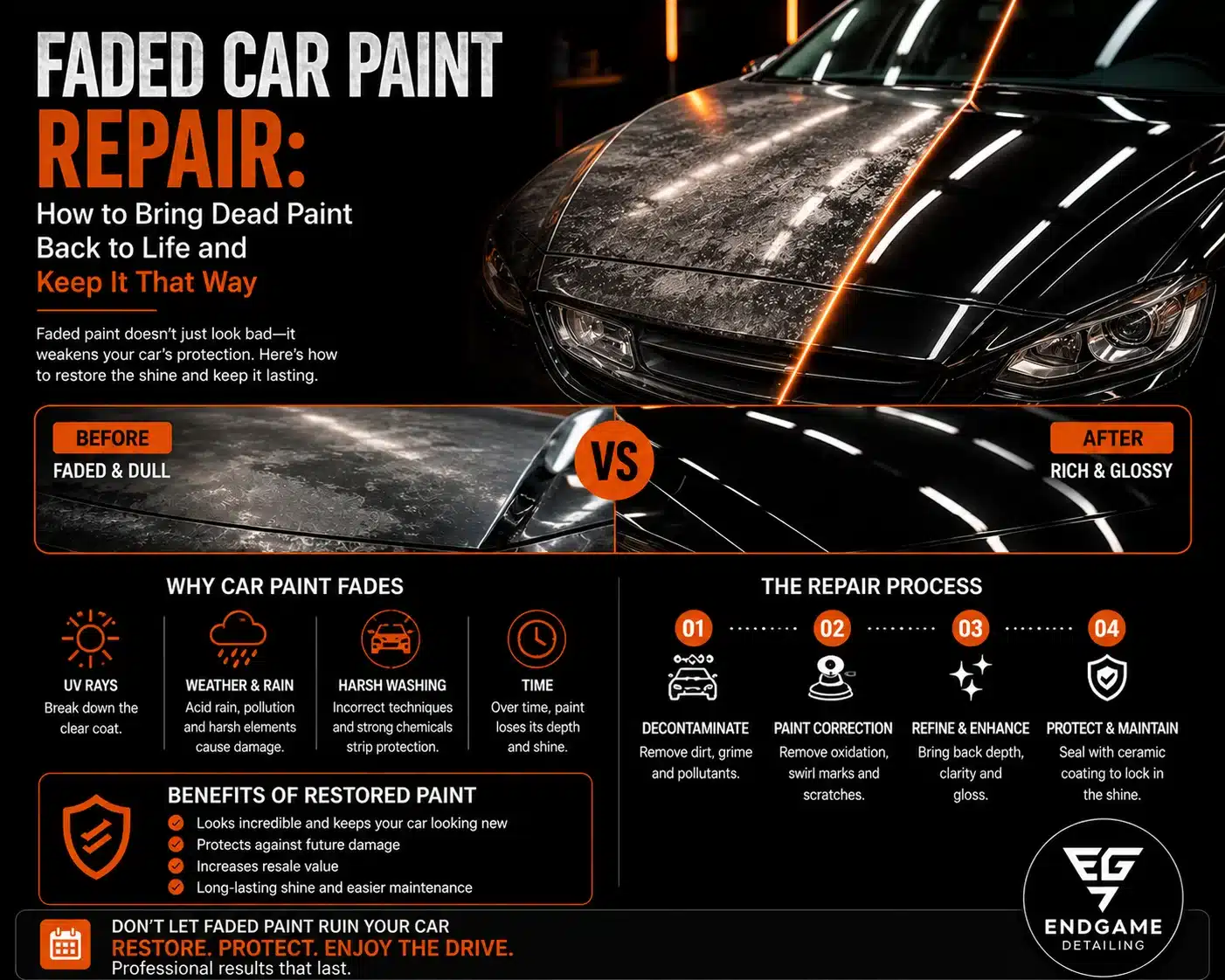
UV radiation is the primary cause. Sydney receives some of the highest UV levels on the planet, and UV breaks the chemical bonds in paint pigments and clear coat. The damage is cumulative: every day your car sits in the sun adds to the total UV exposure the paint has absorbed. Horizontal panels (bonnet, roof, boot lid) fade first because they receive the most direct overhead UV.
Oxidation is the chemical reaction that occurs when the UV-weakened clear coat allows oxygen to react with the paint pigments underneath. The result is a chalky, milky, or hazy appearance that dulls the finish and strips away colour depth. Read more about car paint oxidation and how the process works.
Environmental contaminants accelerate fading. Bird droppings, tree sap, industrial fallout, and road salt all contain acids and chemicals that attack the clear coat and speed up the degradation process. On unprotected paint, these contaminants etch into the surface and create weak points where UV damage concentrates.
Improper washing compounds the problem. Automatic car washes with spinning brushes add networks of fine swirl marks that scatter light across the surface, making fading appear worse than the UV damage alone would cause. The swirls reduce the paint’s ability to reflect light cleanly, which is what gives paint its gloss and depth.
“About half the cars that come to us for faded paint repair are not as far gone as the owner thinks. The paint looks dead, but when we measure the clear coat thickness, there is enough material to correct. The fading is in the outer layer, and once that layer is polished away, the colour underneath is still vibrant.”
Assessing Your Paint: Can It Be Repaired?
Not all faded paint can be saved through correction. The key factor is whether the clear coat is still intact.
| Paint Condition | What It Looks Like | Can It Be Corrected? | What Is Needed |
|---|---|---|---|
| Mild fading | Paint looks dull, lacks depth, water does not bead, slight haze visible in direct light | Yes, fully reversible | Single or multi-stage paint correction |
| Moderate fading and oxidation | Visible chalking (white residue when touched), colour noticeably washed out, haze on dark panels | Yes, mostly reversible | Multi-stage correction, possibly wet sanding on worst panels |
| Severe fading with colour loss | Colour significantly different between sun-exposed and shaded panels, paint feels rough | Partially reversible | Correction improves appearance but cannot fully restore lost pigment |
| Clear coat failure | White rough patches, flaking, peeling, clear coat visibly lifting from base coat | No, beyond correction | Affected panels need respraying, then protection applied to new paint |
The only way to know definitively which category your car falls into is a professional assessment. At Endgame Detailing, every faded paint job starts with a paint depth measurement using a thickness gauge on every panel. This tells us exactly how much clear coat is available to work with and determines the correction approach.
How Professional Faded Paint Repair Works
The repair process follows a structured sequence that removes the damaged outer layer and restores the undamaged paint beneath it.
Step 1: Thorough Wash and Decontamination
Before any machine touches the paint, the car is washed using the proper hand wash method to remove all surface dirt. Then a clay bar treatment is used to remove bonded contaminants (industrial fallout, tar spots, tree sap residue, embedded brake dust) that are stuck to the paint surface. These contaminants must be removed because polishing over them would grind them into the paint and cause further damage.
Step 2: Paint Depth Measurement
A paint thickness gauge is used to measure the clear coat depth on every panel. This is critical for faded paint because the UV damage may have thinned the clear coat unevenly across the car. Panels that have been in direct sun (bonnet, roof, boot) often have less clear coat remaining than shaded panels (lower doors, sills). The measurements guide how aggressively each panel can be corrected without risking a burn-through.
Step 3: Paint Correction
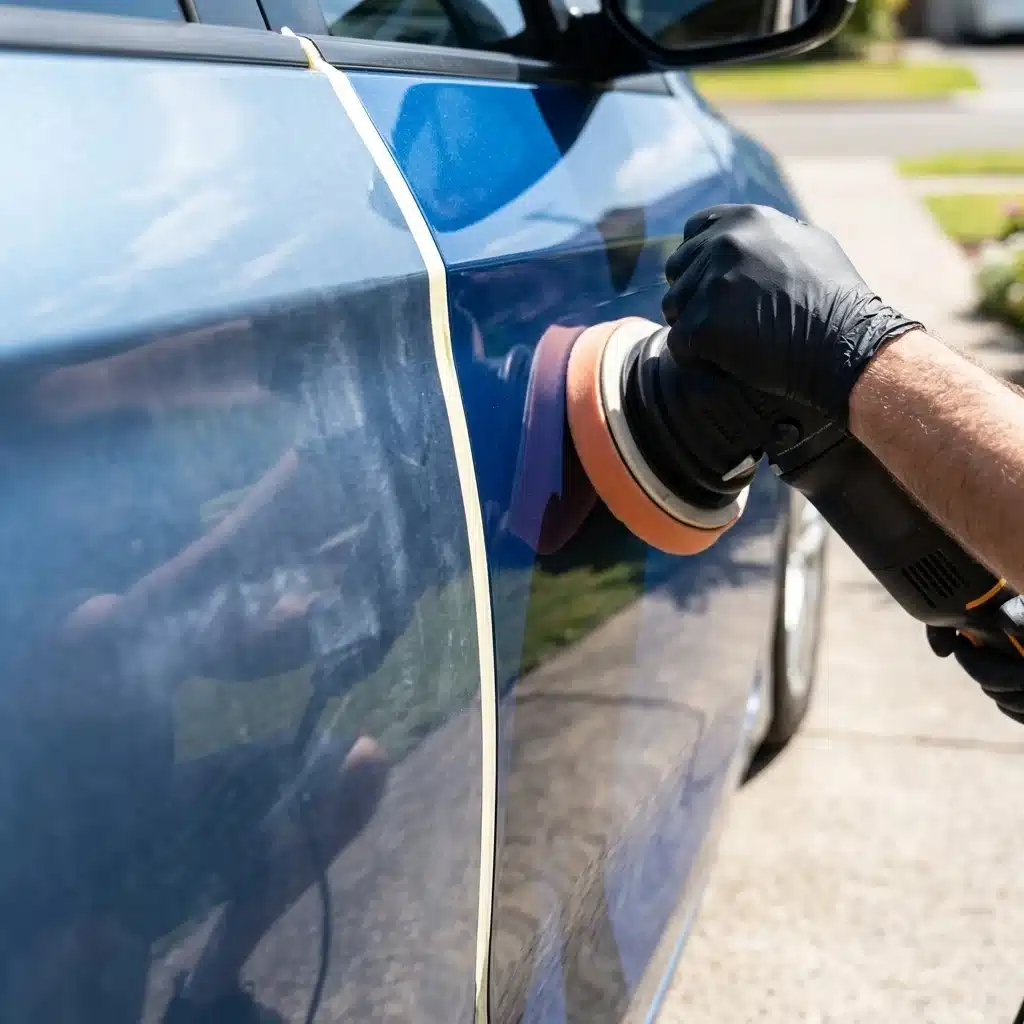
This is where the transformation happens. A dual-action or rotary polishing machine fitted with a foam or microfibre pad is used with a compound (a liquid abrasive) to remove the oxidised, faded outer layer of clear coat.
Single-stage correction uses one compound and pad combination to remove light fading and haze in a single pass. This is sufficient for mildly faded paint.
Multi-stage correction uses progressively finer compounds and pads across two or three stages. The first stage removes the bulk of the damage with a more aggressive compound. The second stage refines the surface and removes the marks left by the first stage. The third stage (if needed) brings the finish to a mirror-like gloss. This is required for moderate to severe fading.
Wet sanding may be needed on the most severely faded panels before machine polishing begins. Wet sanding uses ultra-fine grit sandpaper with water to level the damaged surface before the polishing stages refine it. This removes more material than machine polishing alone and is only used when paint depth measurements confirm there is sufficient clear coat to work with safely.
For a full breakdown of what correction involves and costs, read the cut and polish cost Sydney guide.
Step 4: Panel Wipe and Inspection
After correction, all polishing oils are wiped from the surface with an isopropyl alcohol (IPA) panel wipe. This reveals the true finish without any filler or oil masking remaining imperfections. The car is then inspected under studio lighting from every angle to confirm the correction is complete and consistent across all panels.
Step 5: Protection
This is the step that prevents the fading from returning. Without protection, the freshly corrected paint begins degrading from UV exposure immediately. Within months, the fading cycle starts again.
Ceramic coating is the most popular post-correction protection because it chemically bonds to the clear coat, blocks UV, repels contaminants, and maintains the corrected gloss for two to seven years. Graphene coating offers similar protection with a slicker, glossier finish. For physical protection against stone chips alongside UV blocking, PPF provides the most comprehensive coverage.
For a full comparison of protection options, read the how to protect car paint guide. The ceramic coating vs wax comparison explains why wax alone is not sufficient protection after correction.
Which Colours Fade Worst?
Not all paint colours fade at the same rate. Some pigments are more susceptible to UV breakdown than others.
| Colour | Fading Severity | Why |
|---|---|---|
| Red | Most visible fading | Red pigments are the most UV-sensitive. Red fades to pink or orange over time. |
| Black | Very visible | Black does not “fade” as much as it loses depth. Oxidation creates a grey, chalky haze that is extremely obvious. |
| Dark blue | Very visible | Similar to black. UV breaks down blue pigments, creating a washed-out, milky appearance. |
| White | Least visible | White paint experiences the same chemical degradation but the colour change is less visually dramatic. Yellowing may occur on cheaper whites. |
| Silver and grey | Least visible | Metallic particles in the paint scatter light, which masks mild fading. These colours show UV damage last. |
Regardless of colour, every paint benefits from professional correction and protection. The damage is happening at the same rate; it is just more visible on some colours than others. For colour-specific protection advice, the best paint protection for black cars guide covers the most demanding colour in detail.
What Affects the Cost of Faded Paint Repair
The cost of repairing faded paint depends on the severity of the fading, the size of the vehicle, and how many correction stages are needed.
| Service | What It Covers | What affects the cost |
|---|---|---|
| Single-stage correction | Mild fading, light haze, minor oxidation | Vehicle size and how far the fading has gone |
| Multi-stage correction | Moderate fading, visible oxidation, chalking | Vehicle size, oxidation depth and paint hardness |
| Correction + wet sanding | Severe fading requiring surface levelling before polishing | Severity of the fading and how much levelling is needed |
| Full paint restoration | Extensive correction, scratch removal, water spot treatment, and complete surface recovery | Paint condition across every panel and the correction stage needed |
| Post-correction ceramic coating | Protection to prevent fading from returning | Vehicle size and coating type |
For detailed pricing, read the car detailing cost Sydney guide and the ceramic coating cost breakdown.
A full respray costs far more, depending on the vehicle and the quality of the paint shop. For most cars with fading that has not reached clear coat failure, professional correction achieves a comparable visual result at a fraction of the respray cost while preserving the original factory paint.
Prevention: Why Correction Without Protection Is a Waste
Correcting faded paint without applying protection afterward is like detailing a car and parking it in a sandstorm. The freshly corrected surface is now thinner (because material was removed during polishing) and more vulnerable to UV than the original paint was. Without a protective barrier, the fading cycle restarts immediately.
This is why every correction job at Endgame Detailing includes a protection recommendation. The correction restores the finish. The protection preserves it. Together, they deliver a result that lasts years, not weeks.
For new car owners who want to prevent fading before it starts, the new car paint protection guide explains why applying protection within the first few weeks of ownership delivers the best long-term outcome. For owners planning to sell, the pre-sale car detailing guide covers how correction and protection maximise resale value.
For a visual sense of what correction achieves on faded paint, browse the car detailing before and after guide and the project gallery.